DHS Docket No. USCIS-2025-0370
Administrative Alternative for Immediate Asylum Backlog Reduction
A proposal to separate humanitarian protection adjudication from provisional labor participation through a voluntary compliance framework — reducing the asylum backlog while preserving statutory protections.
The Proposal in Plain Language
Right now, many people file asylum applications not because they are fleeing persecution, but because it is the only way to legally identify themselves to the government and work while they wait for other immigration options. This clogs the asylum system with millions of cases, making everyone — including genuine refugees — wait years for a decision. The government's current fix is to take away work permits during that wait, hoping fewer people will file. But that doesn't actually remove any cases from the pile; it just makes the waiting period harder to survive.
This proposal offers a different path. Instead of punishing people for waiting, it lets individuals who really just want to work voluntarily give up their asylum case and enter a supervised employment program. Every person who enrolls immediately removes one case from the backlog. They get a special work ID — not a green card, not citizenship, just a monitored permit to work and pay taxes legally. Genuine asylum seekers stay in the protection system where they belong, while the rest move into a track that actually matches what they need. The result: a smaller backlog, a cleaner asylum system, and more people working and paying taxes on the books.
The Core Concept
A framework that addresses backlog reduction without compromising humanitarian obligations.
Preserves Asylum Eligibility
Does not alter statutory eligibility for asylum or any form of humanitarian protection.
No Pathway to Citizenship
Does not create, imply, or establish a pathway to lawful permanent residency or citizenship.
Employment-Compliance Track
The core mechanism is a monitored, regulated employment-compliance track with full tax reporting.
Voluntary Participation
Individuals may elect to withdraw a pending asylum application in exchange for regulated workforce participation.
1 : 1
Case Reduction Ratio
Each participant who voluntarily enters the employment-compliance track immediately removes one pending case from the adjudicative docket — a direct, measurable reduction.
Employment Compliance Identifier
A nine-digit identifier distinguishable from Social Security numbers, enabling regulated workforce participation and full tax compliance.
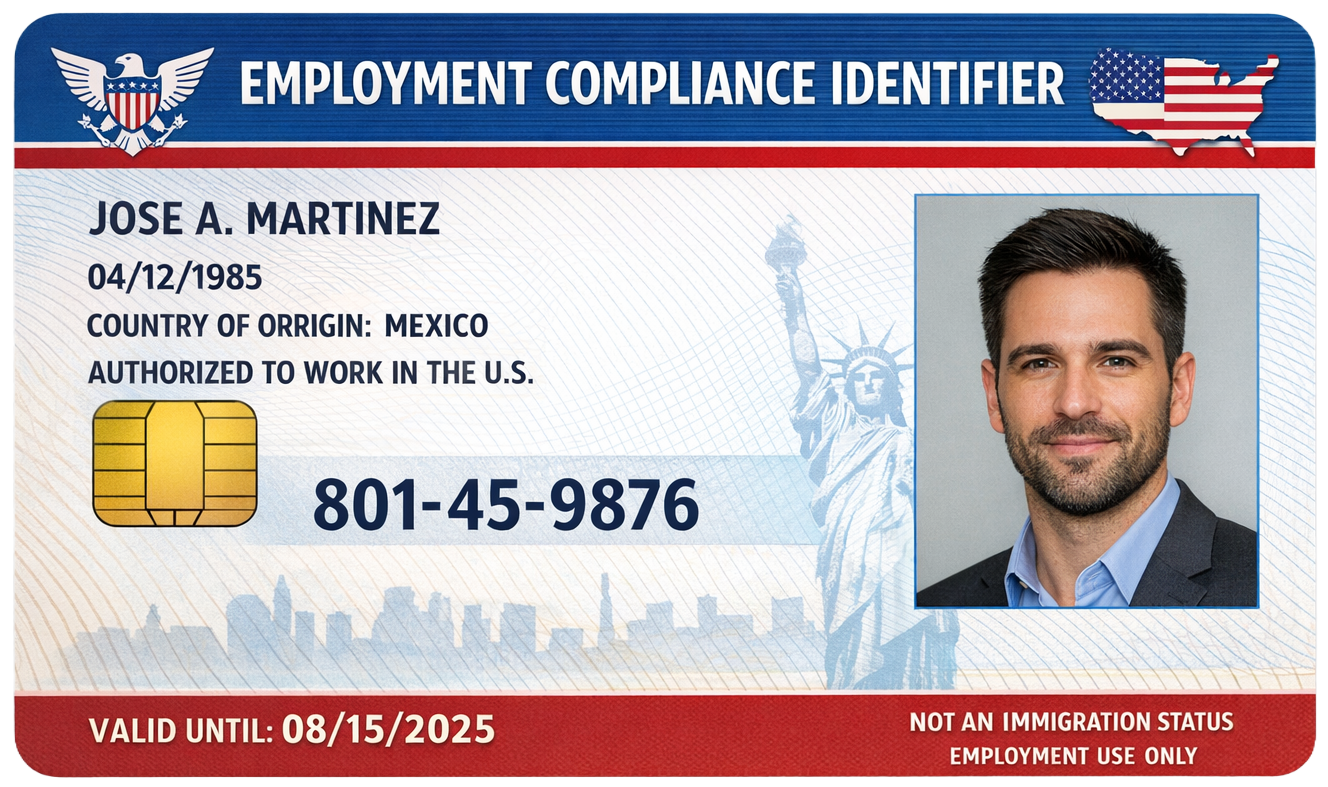
Valid only for employment reporting and tax withholding
Does not constitute immigration status
2-year window to secure qualifying employment
Minimum 600 cumulative active days required
Participation Process
Voluntary Withdrawal and Employment Compliance Registration Alternative
Eligibility limited to current asylum applicants
Participation is available only to individuals with a pending asylum application who choose to enter the alternative administrative track.
Voluntary withdrawal of asylum application
The participant formally withdraws the pending asylum case as a condition of enrollment. Upon acceptance, the case is removed from the adjudication docket.
Identity verification and security screening
The individual appears at a designated USCIS office for fingerprinting, biometric capture, and background checks conducted through standard federal criminal and security databases.
Issuance of the Employment Compliance Identifier (ECI)
After confirmation of identity and absence of disqualifying criminal convictions (such as serious criminal offenses or court-imposed incarceration), the participant receives the ECI card.
Employment activation period
A compliance clock begins. The participant has up to two years to obtain qualifying employment and must maintain verified payroll activity for a cumulative minimum of 600 days. Employment may occur with multiple registered employers. Temporary interruptions due to documented medical conditions or similar admissible circumstances may be excused within program guidelines.
Transition after sustained compliance
After two years of compliant employment and continued good conduct, the participant becomes eligible to receive a standard Employment Authorization Document (EAD) and a limited travel authorization ("combo card") valid for five years.
Renewal eligibility
The EAD and travel authorization may be renewed for an additional five-year period provided the participant maintains compliance and has no disqualifying criminal convictions during the participation period.
Designated High-Demand Sectors
Participants must secure and maintain qualifying employment within federally designated labor-shortage sectors.
Agriculture & Primary Production
Seasonal and year-round roles in crop cultivation, livestock management, and agricultural support operations.
Food Processing & Distribution
Positions in food manufacturing plants, packaging facilities, cold-chain logistics, and distribution networks.
Commercial Food Preparation
Roles in institutional and commercial kitchens, catering operations, and food service establishments.
Healthcare & Caregiving Services
Support positions in hospitals, nursing facilities, home health aide services, and assisted living centers.
Construction & Skilled Trades
Roles in residential and commercial construction, infrastructure projects, and licensed trade apprenticeships.
Logistics & Warehousing
Positions in freight handling, warehouse operations, last-mile delivery, and supply-chain support services.
Systemwide Impact & Advantages
A framework designed to produce measurable outcomes for the immigration system, the labor market, and public fiscal accountability.
Immediate Caseload Reduction
Each voluntary participant directly removes one pending case from the asylum adjudicative docket.
Improved Resource Allocation
Freed adjudication capacity can be redirected to meritorious asylum claims requiring protection.
Tax Compliance & Accuracy
Full tax withholding and reporting via the ECI system increases federal and state revenue accuracy.
Preserves Statutory Protections
The framework does not restrict lawful presence during adjudication or alter existing asylum law.
What This Proposal Fixes from the Original DHS Docket
DHS Docket No. USCIS-2025-0370 seeks to reduce asylum backlog by restricting employment authorization. This proposal identifies the structural shortcomings of that approach and offers direct alternatives.
Modifies waiting conditions, not backlog size
The DHS rule changes what applicants experience while pending — not whether cases remain pending. Adjudicative workload stays the same.
Each ECR enrollment removes a case from the docket immediately, producing a direct and measurable backlog reduction.
Relies on indirect behavioral deterrence
Restricting employment authorization assumes applicants will stop filing. But individuals remain eligible to file, and every application still requires full adjudication.
The compliance track eliminates the incentive to file a placeholder asylum claim by offering a lawful employment channel outside the humanitarian system.
Merges two distinct populations into one queue
The current system forces protection seekers and labor-participation seekers into the same adjudication pipeline, overwhelming asylum officers.
The proposal separates them administratively — protection claims stay in asylum; employment-motivated individuals move to a supervised compliance track.
Does not address processing capacity or intake volume
The rule leaves intake, screening, interview, and decision steps unchanged for every pending application, so the backlog persists regardless of employment restrictions.
Companion measures — early merits screening, filing integrity certification, priority decision tracks, and expanded officer authority — directly target processing bottlenecks.
Penalizes subsistence without reducing filings
Removing work authorization affects how applicants survive during adjudication but does not change how many cases require review.
By tying enrollment to voluntary asylum withdrawal, the proposal converts each participant into an immediate reduction in pending caseload while preserving full humanitarian protections.
The Ten-Year Bar and Its Behavioral Effect on Asylum Filing Decisions
Recent migration data and search-behavior analysis from 2025–2026 indicates that a substantial portion of asylum system demand is driven not solely by protection claims, but by structural limitations in adjustment-of-status pathways. The interaction between prolonged processing times, enforcement-centric policy changes, and the unlawful-presence reentry bar has created a predictable decision pattern: remaining inside the asylum process functions as a legal preservation strategy rather than purely a humanitarian claim.
The asylum backlog exceeded 3.9 million pending cases, with average adjudication timelines approaching four years in immigration court. Search interest shifted from "how to apply for asylum" to "asylum status check," "maintain status," and "processing time" — indicating applicants are primarily attempting to remain within a lawful procedural posture during extended waiting periods.
The Behavioral Constraint: A Rational Decision Structure
Within this environment, the ten-year unlawful-presence bar operates as a decisive behavioral constraint. Individuals who depart the United States after extended presence may become inadmissible for a decade, even if they later qualify for employment-based or family-based immigration categories. This produces a rational decision structure:
Depart and regularize through normal channels
Triggers 10-year inadmissibility bar
Remain in asylum proceedings
Lawful procedural presence for several years
Immigrant Population Metrics
The data reinforces this behavioral response. During the same period that net migration turned negative and enforcement activity increased, asylum search activity rose while labor participation among immigrants declined by approximately 750,000 workers — demonstrating that many individuals were remaining in a legal holding posture rather than transitioning into formal labor pathways.
| Metric | Jan 2025 | Jun 2025 | Historical Context |
|---|---|---|---|
| Total Immigrants in U.S. | 53.3 Million | 51.9 Million | Record high in Jan 2025 |
| Percentage of U.S. Population | 15.8% | 15.4% | Exceeded 1890 peak (14.8%) |
| Immigrant Share of Labor Force | 20% | 19% | Decline of ~750,000 workers |
| Net Migration Estimate | N/A | -10k to -295k | First negative net migration in 50 years |
The consequence is not merely individual decision-making but system-level congestion. The asylum framework unintentionally becomes the only administrative channel that preserves presence while future eligibility options develop. The longer adjudication timelines extend, the stronger this lock-in effect becomes.
Applicants whose objective is eventual legal employment eligibility have little incentive to leave the queue, even when protection eligibility is uncertain, because the alternative produces a fixed statutory penalty unrelated to the merits of the future application.
The Waiver Solution
A conditional waiver of the ten-year bar tied specifically to voluntary withdrawal and enrollment in the Employment Compliance Identifier program changes the incentive equation — it does not expand immigration benefits or create status eligibility; it removes the structural penalty that discourages accurate pathway selection.
Remain in asylum to avoid inadmissibility
Safely exit asylum if protection not needed
Protection system used as presence preservation
Protection system used only for protection claims
Backlog stabilized by risk avoidance
Backlog reduced through voluntary case removal
Systemic Benefits of Bar Removal
Direct Backlog Reduction
Each voluntary participant directly removes one pending case from the adjudicative docket, preserving resources for genuine asylum seekers.
Promotion of Family Unity
Repealing the bar for compliance-track participants allows families to complete legal status transitions without lengthy separation.
Transition to Lawful Pathways
Successful completion of the ECI compliance period grants eligibility to transition into employment-authorized or immigrant categories without statutory barriers.
Economic Integrity
The ECI creates a monitored labor participation framework requiring a clean criminal record and continuous employment in high-demand sectors.
This does not grant immigration status or permanent residence — it removes the structural penalty that discourages accurate pathway selection, restoring the intended separation between humanitarian protection adjudication and employment-based immigration pathways.
Final Request to the Department
The Department is respectfully encouraged to evaluate asylum backlog reduction not solely through accelerated adjudication, but through structural separation of protection-based and labor-based immigration intent. By combining incentivized voluntary withdrawals, early credible-fear screening, employer-linked compliance infrastructure, and the removal of punitive re-entry bars for voluntary participants, this proposal offers a legally grounded, fiscally responsible, and operationally scalable path to reducing the asylum backlog by an estimated 80% — without compromising due process or protection for those who truly need it.